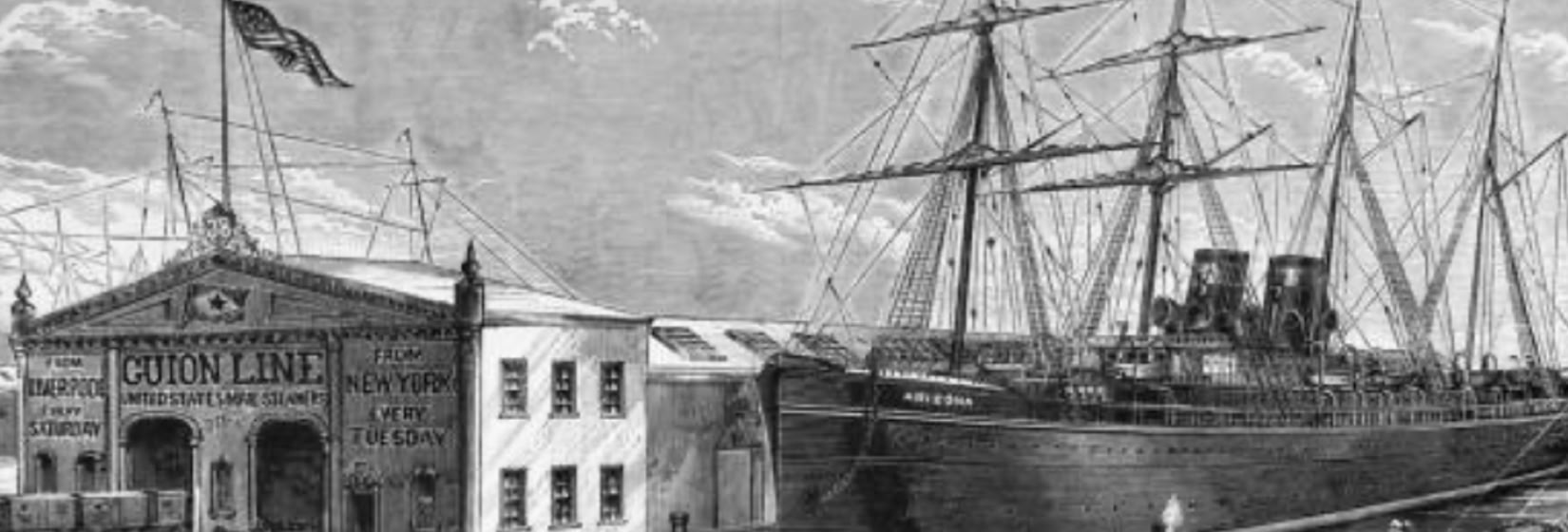
In New York City of 1882, the Statue of Liberty was not yet in the harbor, the Brooklyn Bridge was still being constructed; and the tallest building was Trinity Church. It was a gas-lit city of a million people living through a time of growth that encompassed the gentrification of a commercial district around the Ladies' Mile, and residential displacement as the city's wealthy moved uptown.
Such was Wilde's milieu when he arrived for his first lecture on January 9, 1882 at Chickering Hall.
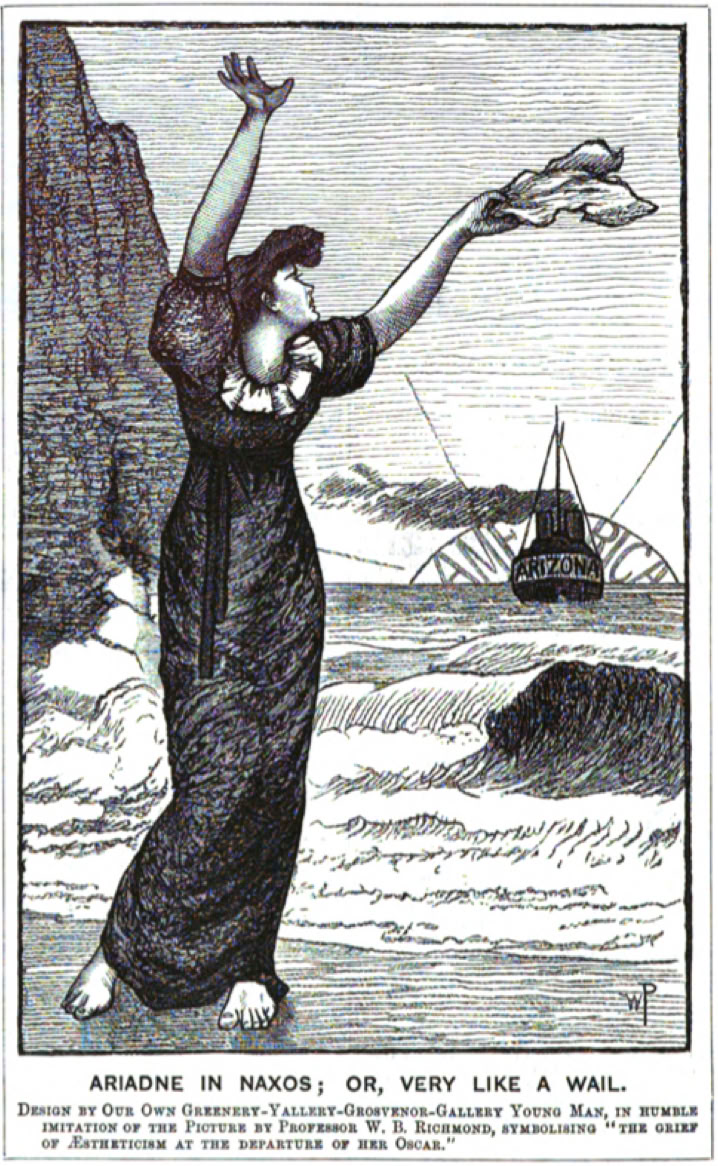
Punch cartoon depicting Wilde’s departure for America in mythical terms.
See: Ariadne in Naxos
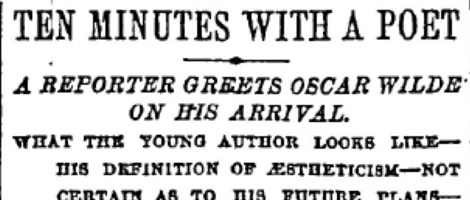
INTERVIEW
“Ten Minutes with a Poet,”
The New York Times, Jan. 3, 1882, 5
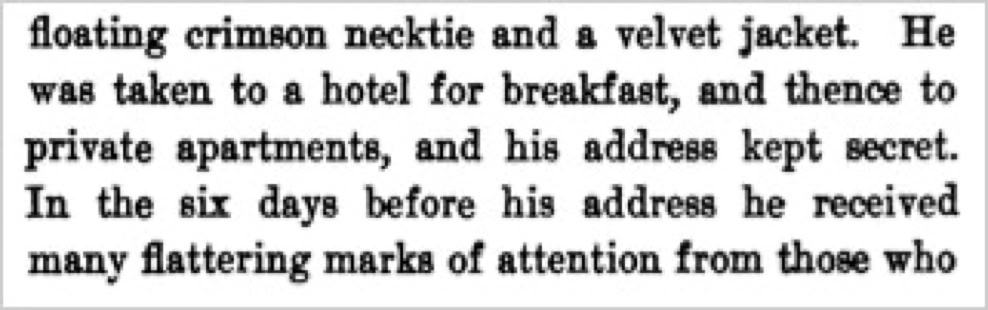
There is some confusion about Wilde lodging upon arrival. A newspaper report [2] says that, after disembarking, Wilde's party 'drove off to the Brunswick Hotel', although this may have been only for breakfast as Wilde's manager, Col. W.F. Morse, recalled many years later [3]:
In an interview with the Boston Globe Wilde said, 'In New York there were about a hundred [reporters] a day. I had to leave my hotel and go to a private house when I wanted to push along my work'. [4] Wilde's refuge was a private apartment on 28th Street. The location was ostensibly to be kept secret, although he still did give the occasional interview from this address [5].
It is not clear whether Wilde checked into a hotel, although this seems likely, and used the house intermittently as required for writing. Neither has the hotel itself been identified, but there is a strong possibility that it was the Grand Hotel (the building is extant at 31st Street and Broadway). This assumption derives from the sometimes unreliable 1936 source book for Wilde's tour Oscar Wilde Discovers America: 1882 in which the desk clerk of the Grand, reportedly a Michael Toner, gave details of Wilde's arrival and stay to the authors in preparation for the book, albeit over 50 years after the event [6]. It is possible that Toner might have been remembering a later stay, as Wilde is known to have lodged at the Grand on at least two occasions later that year on return visits to New York City.
One of the most celebrated quotations by anyone is the remark attributed to Oscar Wilde at New York Customs at the start of his lecture tour of America in 1882.
He is supposed to have said, “I have nothing to declare, except my genius”.
Unfortunately, there is no primary source evidence that Wilde made this statement, and all indications are that the myth developed many years later, after Wilde death in 1900.
See: DUBIOUS QUOTATION: Nothing to Declare
See BLOG ARTICLE: Something to Declare
Footnotes
[1] Castle Garden (now Castle Clinton) was the point of entry for visitors to New York and a major receiving station for immigrants prior to the opening of Ellis Island some ten years later.
[2] New York Evening Post , January 4, 1882, 4.
[3] The Writings of Oscar Wilde (A.R. Keller & Co., 1907, 76), Ch. IV American Lectures by W.F. Morse.
[4] Boston Globe, January 29, 1882, 5.
[5] New-York Tribune , Jan 8, 1882, 7.
[6] Lloyd Lewis and Henry Justin Smith, 1936, p.35.